

Financial Education for Citizens
What is high-quality financial education?
We define financial education as any activity designed to enable citizens to acquire the skills they need to achieve their personal and family goals, as defined throughout their lives and in accordance with their priorities.
Why is financial literacy important?
In the past, the life cycle it was easier to interpret than it is today and more predictable, it was linear: once you’d finished your studies, you’d start work straight away, get married, have children and work until retirement at the same company or in the family business. Life’s events were well-paced; they had a rhythm to them.
Things have changed today, the INE tells us that our first job rarely coincides with the end of our studies, financial independence is achieved very late – on average at the age of 34 – we become mothers at 40, and we retire at 67.
Against this backdrop, financial education becomes an essential tool. It equips you to adapt to change, analyse your financial needs at different stages of life and make informed decisions, regardless of the challenges that may arise.
We now know that our working or business life will have changes and ups and downs, once we’ve got married and had children, there’s a chance we’ll end up divorced and embark on new personal projects. We can’t expect things to follow a linear path; rather, we need to think in terms of recurring beginnings and endings.
Which financial education programme?
Financial education is effective if it makes people aware of their own needs and enables them to identify the best solutions.
According to the OECD, financial education is not simply a course, a book, a seminar or a workshop; it is a process of acquiring knowledge and using tools and services that bring about a change in habits and attitudes. A financial education programme enables you to make sound decisions about saving, investing, borrowing and more. You will acquire the skills to manage your personal and family finances efficiently.
With so many options available on the market, How can we identify high-quality financial education? How do I know which financial education to invest my time and money in?
Our programmes are based on technical standards and are delivered by certified and qualified professionals, ensuring reliable and robust results.
How can you recognise high-quality financial education?
You must meet four requirements
1. That it is based on technical quality standards
2. That they use approved tools

3. That it is delivered by qualified and authorised professionals
4. That enables learners to acquire the knowledge and skills to:
- Analyse the strengths and weaknesses of the family life cycle; define life goals; assess the economic and financial situation; Maximise savings; plan for protection, retirement, investment and debt; choose the right type of products by comparing prices and quality; seek help and know which professionals to consult.

1. That it is based on technical quality standards
2. That they use approved tools
3. That it is delivered by qualified professionals
4. That enables learners to acquire the knowledge and skills to:
Malgovik
One technical quality standard It is a voluntary document that sets out technical specifications based on experience and technological developments. It is the result of a consensus amongst the parties involved and must be approved by a recognised standards body, in accordance with Act 21/1992.
In financial education, the following applies: UNI 11402 technical standard, which sets out the requirements for both financial education activities and the professionals who deliver them.
As with any activity, tools are key to acquiring a high-quality financial education.
In financial education, what ensures that the results are objective – that is, that financial education is not being used as a marketing tool – is that the materials and software used are accredited and comply with the technical quality standards for financial education. This guarantees objective and concrete results.
In financial education, the vocational qualification The person delivering the training is crucial to achieving real results. In Spain, the certification that accredits the knowledge and skills required to provide high-quality financial education is that of the Association of Financial Educators and Planners (AEPF). Members of the public can check on their website whether a professional is certified and enabled, a key aspect, as without accredited tools and up-to-date training it is not possible to provide high-quality financial education.
– Analyse the strengths and weaknesses of the family life cycle; define life goals; assess the economic and financial situation; Maximise savings; plan for protection, retirement, investment and debt; choose the right type of products by comparing prices and quality; seek help and find out which professionals to consult.
Lorem ipsum dolor sit amet, consectetur adipiscing elit. Ut elit tellus, luctus nec ullamcorper mattis, pulvinar dapibus leo. Consectetur adipiscing elit, sed do elit tellus.

Our qualified teachers
The financial education and planning service provided by CS Financial Planning complies with the UNI 11402 technical quality standard «Financial education for citizens: service requirements», which sets out the requirements for the design, implementation, delivery and evaluation of this activity, as well as the requirements for providers of this service.
We provide this service through financial educators accredited by the AEPF, who have been trained and equipped with approved IT tools to carry out personal projects in accordance with the quality requirements of the technical standard.
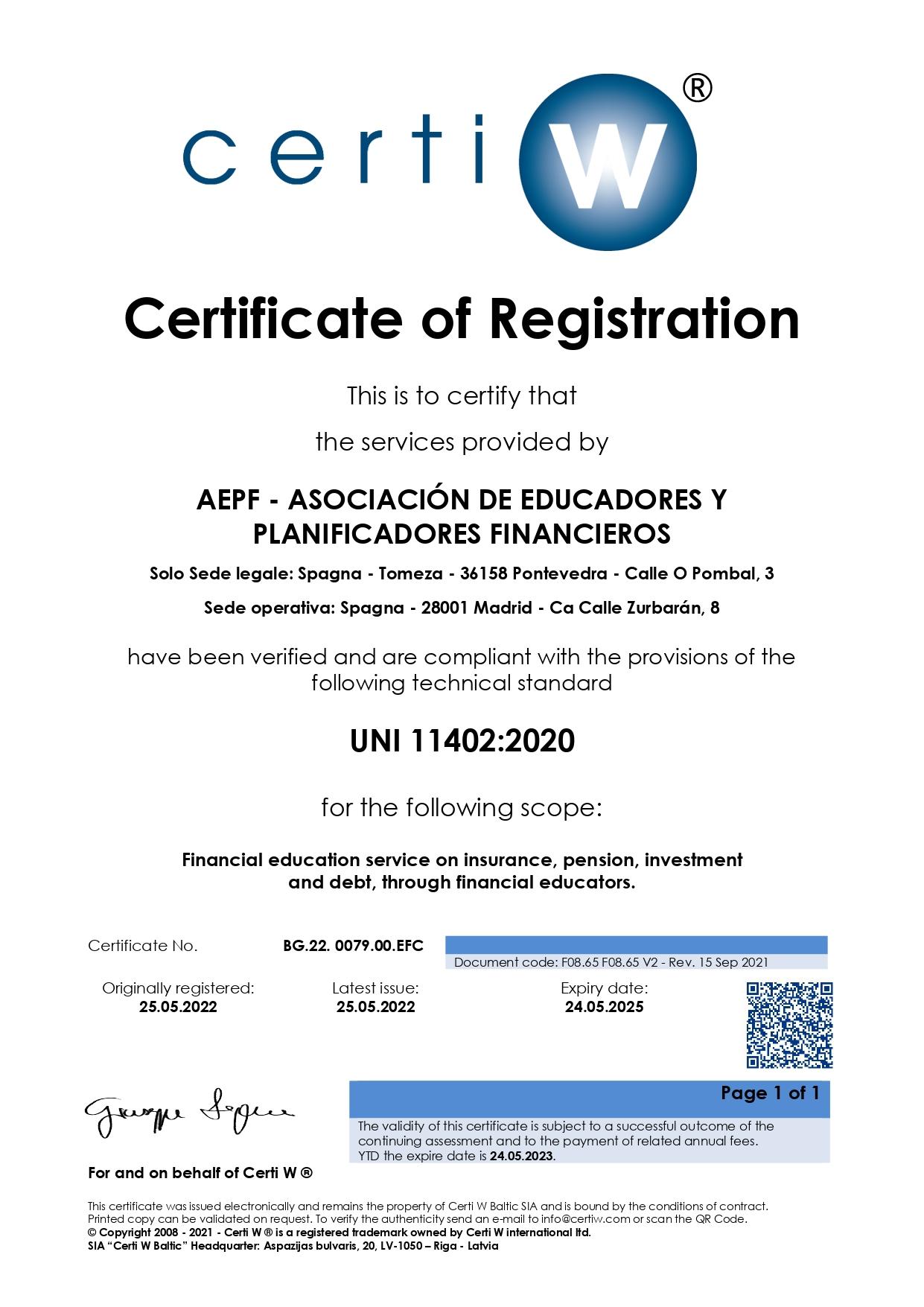
The AEPF, financial educators and the tools used are periodically reviewed by an independent external audit, which ensures maximum reliability, rigour and consistency with technical standards. (Photo: current audit certificate).